
IRD Invoice Numbering Rules – Sequential numbering of Tax Invoices (Bills)
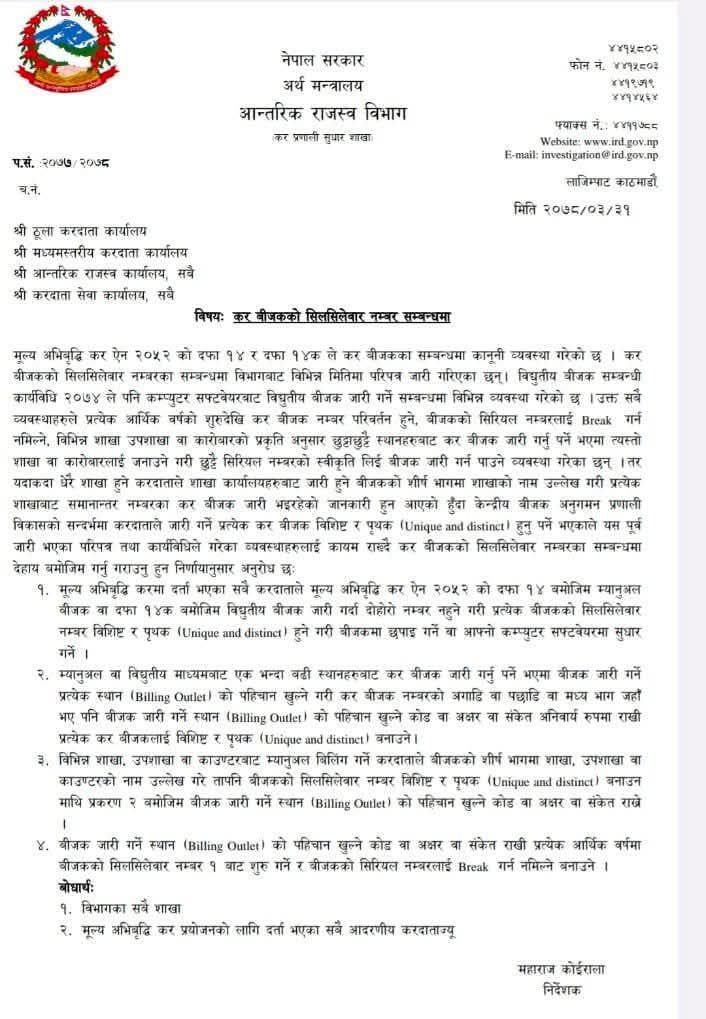
The IRD has outlined four primary rules for taxpayers:
1. Unique Sequential Numbering:All taxpayers (manual or electronic) must ensure that invoice numbers are unique and distinct. There should be no duplication of numbers within the same fiscal year.
2. Billing Outlet Identification:If a business issues invoices from multiple locations (branches, sub-branches, or different counters), they must include a specific code, letter, or symbolin the invoice number to identify the exact "Billing Outlet." This code can be placed at the beginning, middle, or end of the invoice number.
3. Branch Transparency: Even if the branch name is printed at the top of the bill, the invoice number itself must still carry the unique outlet identifier mentioned above.
4. No "Breaks" in Series:The serial numbering must start from 1 at the beginning of every fiscal year and continue sequentially. You are not allowed to "break" the series or skip numbers.
Practical Example
Imagine a business named "Eco-Trade" that has a main office in Kathmandu and a branch in Pokhara.
Under these rules, they cannot simply use "Invoice #1" at both locations. They must differentiate them using an outlet code (e.g., KTM for Kathmandu and PKR for Pokhara).
| Location | Fiscal Year | Invoice Number Format | Sequence Example |
| --- | --- | --- | --- |
|Kathmandu (Main)| 2082/83 | KTM-01-00001 | KTM-01-00001, KTM-01-00002... |
|Pokhara (Branch) | 2082/83 | PKR-01-00001 | PKR-01-00001, PKR-01-00002... |
Why this matters:
If the IRD sees two different "Invoice #101" in their system without these codes, it triggers a red flag for potential tax evasion or duplicate billing. By adding the KTM or PKR prefix, each bill becomes "Unique and Distinct."